
A Curated Book List
High summer is a season of gardens in full growth, busy pollinators, long warm days, and thriving habitats. This collection of picture books explores the richness of midsummer through nature, community, seasonal celebrations, and the many relationships that shape life outdoors.
In Simple Terms:
High summer is a season of abundance. Gardens start producing food, pollinators are everywhere, and many different forms of life share the same spaces.
At a Glance: High Summer Through Stories
- 30 picture books for midsummer reading
- Gardens, pollinators, and thriving habitats
- Community celebrations and outdoor traditions
- Nature, cooperation, and shared ecosystems
- Observation ideas that connect stories with the living world
Why this matters:
By high summer, the season feels full. Gardens, insects, birds, and people all become part of the same seasonal rhythm. Reading stories alongside nature observations helps us notice how these relationships create healthy, living communities.
Explore Seasonal Books
Looking for stories tied to a specific season?
You may also enjoy our quick visual guides:
• Spring Books for Children
• Summer Nature Stories
• Autumn & Harvest Picture Books
• Winter Read-Aloud Stories
• Books About the Seasons
☀️ Reading During High Summer
By high summer, the season has settled into its rhythm.
Gardens begin to produce food, flowers attract a steady stream of pollinators, and birds, insects, and other wildlife seem to be active everywhere at once. What felt new in June now feels familiar.
The books in this collection explore many parts of midsummer. Some celebrate thriving gardens and busy pollinators. Others focus on outdoor traditions, community celebrations, and the connections between living things.
Together they reveal that even the busiest season is held together by balance. Whether you’re reading about honeybees, butterflies, fireworks, baseball games, or backyard discoveries, each story offers another way to notice the richness of high summer and the many lives sharing it.
Disclosure: This post contains affiliate links. As an Amazon Associate, I earn from qualifying purchases at no additional cost to you.
☀️ Gardens in Full Growth
As we reach high summer, gardens have moved beyond beginnings.
Leaves overlap, flowers open in layers, and fruits and vegetables begin appearing among the growth. Farms and gardens become busy places where plants, insects, animals, and people all participate in the work of the season.
These summer nature stories explore gardens, food, farms, and the small relationships that allow living spaces to flourish. Together, they capture the abundance of midsummer and the care, cooperation, and attention that growth requires.
Themes in this Section:
gardening · farms · harvest · pollinators · cooperation
✦
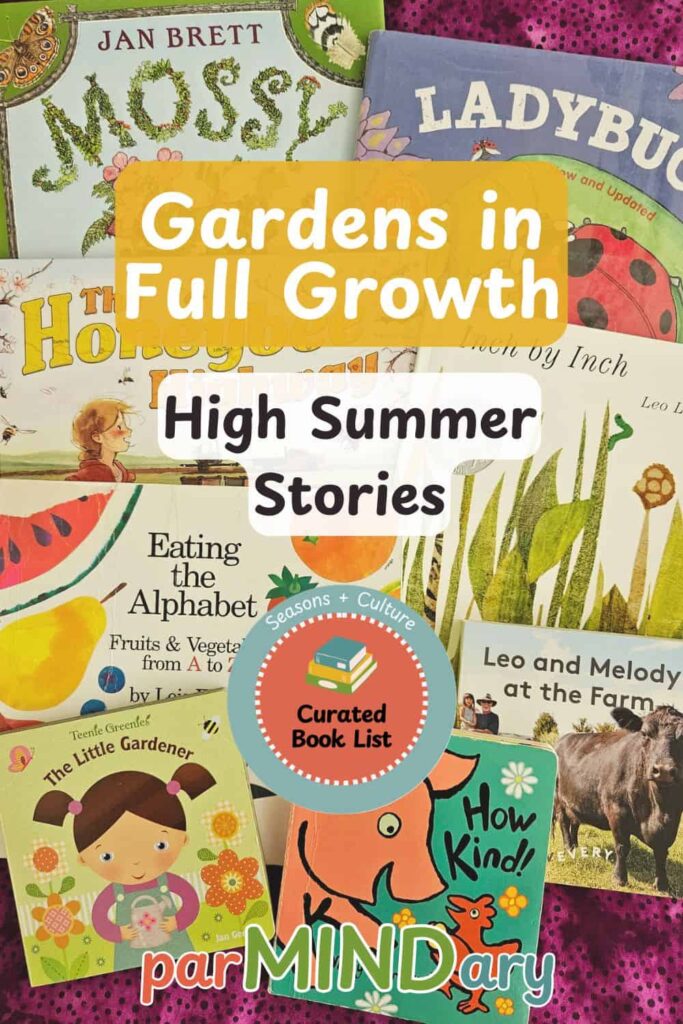
The Little Gardener – Jan Gerardi
Watch a small garden flourish through patient care and everyday attention.
Why this book matters: Simple gardening tasks become part of a larger story about nurturing living things. Gentle illustrations and interactive flaps show how steady care shapes the world around us.
Themes / patterns: gardening, responsibility, growth, seasons, observation
Age range: 1–3
Find The Little Gardener on Amazon
Eating the Alphabet – Lois Ehlert
Discover a colorful alphabet filled with fruits and vegetables from around the world.
Why this book matters: Bright illustrations introduce an incredible variety of edible plants while encouraging curiosity about where food comes from. It’s an easy companion for gardens, farmers markets, and summer harvests.
Themes / patterns: food plants, harvest, diversity, gardens, healthy eating
Age range: 1–3
Find Eating the Alphabet on Amazon
Inch by Inch – Leo Lionni
One clever inchworm solves problems by measuring the world around him.
Why this book matters: Measurement becomes part of a playful story about creativity and perspective. It naturally invites conversations about comparing sizes and noticing details in the living world.
Themes / patterns: measurement, observation, problem solving, nature, creativity
Age range: 2–5
Find Inch by Inch on Amazon
Leo and Melody at the Farm – Lovevery
Join Leo and Melody as they discover the daily rhythms of life on a farm.
Why this book matters: Young readers can use their senses to connect with the work that supports farms and food production. A fun day on the farm becomes an opportunity to notice relationships between people, animals, and the land.
Themes / patterns: farms, responsibility, food, community, daily rhythms
Age range: 2–4
Find Leo and Melody at the Farm on Amazon
The Honeybee Highway – Shanna Upchurch
Ride along with a young beekeeper as thousands of honeybees travel to pollinate crops across the country.
Why this book matters: This story reveals an often unseen part of agriculture, showing how honeybees, farmers, and beekeepers all depend on one another. It encourages readers to think about the remarkable journeys that support everyday life.
Themes / patterns: honeybees, pollination, agriculture, cooperation, seasonal cycles
Age range: 4–9
Find The Honeybee Highway on Amazon
Mossy – Jan Brett
Meet a remarkable turtle whose shell becomes a tiny garden of its own.
Why this book matters: Mossy’s story gently explores respect for wildlife and the importance of allowing animals to live where they belong. It encourages careful observation and appreciation for the natural world.
Themes / patterns: wildlife, belonging, habitat, kindness, nature
Age range: 3–7
Find Mossy on Amazon
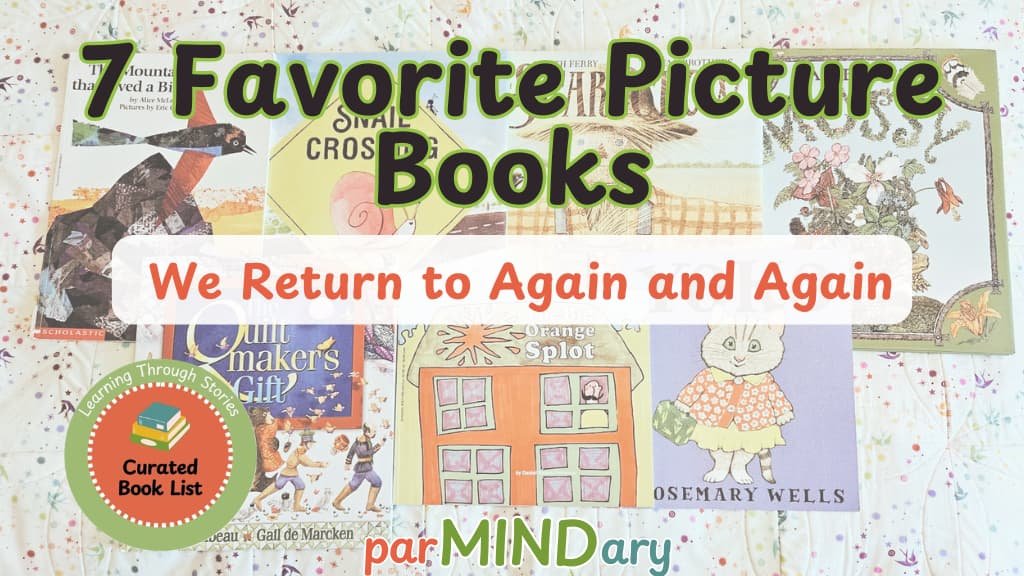
You can also find Mossy in our 7 Favorite Picture Books list, which focuses on friendship, caring, and change over time.
Ladybugs – Gail Gibbons
Discover how ladybugs grow, hunt, and contribute to healthy gardens.
Why this book matters: Clear illustrations and accessible facts introduce the life cycle of one of the garden’s most familiar insects. Readers begin seeing ladybugs as an important part of a thriving ecosystem.
Themes / patterns: ladybugs, life cycle, insects, gardens, ecosystems
Age range: 4–8
Find Ladybugs on Amazon
How Kind! – Mary Murphy
One kind act spreads from neighbor to neighbor until everyone is included.
Why this book matters: Simple acts of kindness ripple through a farmyard, showing how relationships grow through everyday choices. It pairs beautifully with stories about thriving habitats and shared spaces.
Themes / patterns: kindness, community, cooperation, friendship, belonging
Age range: 1–4
Find How Kind! on Amazon
As gardens fill with life, the creatures moving through them become easier to notice.
☀️ Busy Summer Creatures
High summer is rarely still when we look closely.
Spiders build webs, butterflies move between flowers, birds call from trees, and insects carry out their work throughout the day. Even quiet gardens are filled with motion, sound, and repeated activity.
These stories bring summer’s smaller creatures into focus. Some follow individual journeys, while others reveal the patterns connecting pollinators, plants, food, and habitat across the season.
Themes in this Section:
insects · biodiversity · habitats · nature · observation
✦
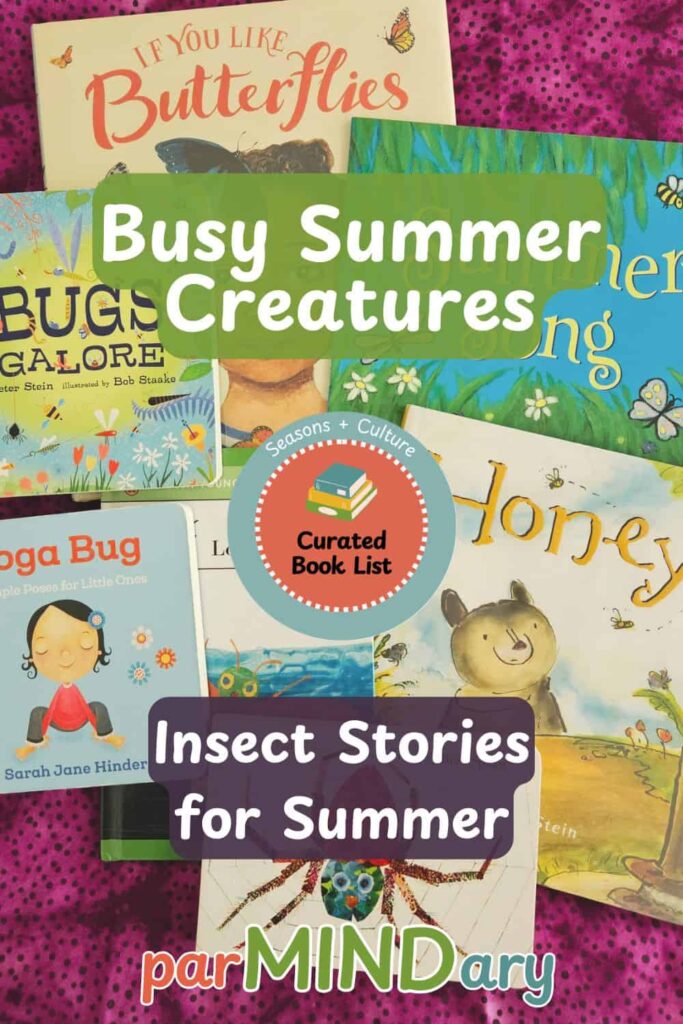
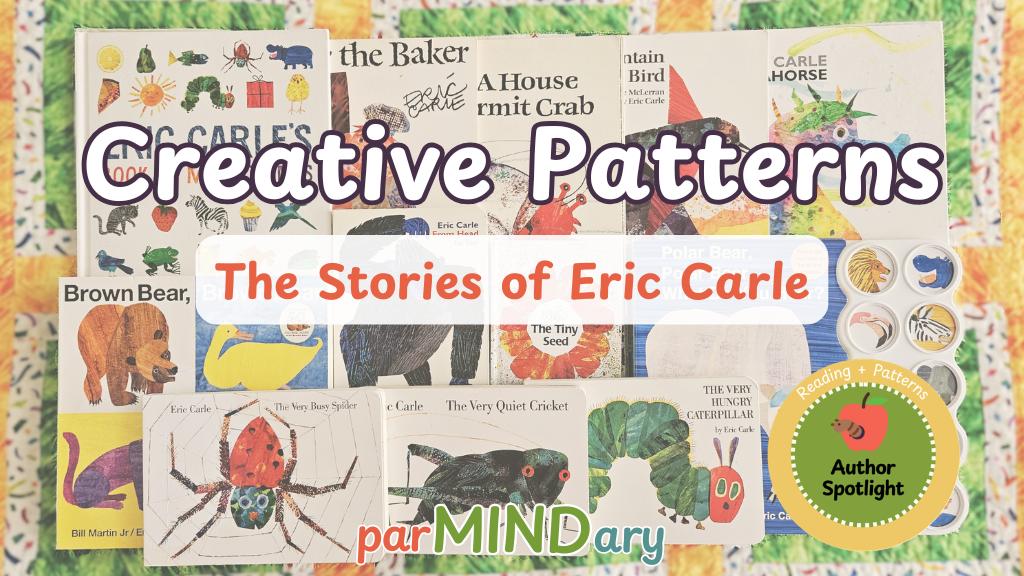
The Very Busy Spider – Eric Carle
Watch a determined spider patiently spin her web despite constant interruptions.
Why this book matters: The familiar farm setting introduces perseverance while quietly highlighting one small creature’s important role in its habitat. It encourages readers to slow down and watch the lives unfolding around them.
Themes / patterns: spiders, perseverance, habitats, observation, farm life
Age range: 1–4
Find The Very Busy Spider on Amazon
Bugs Galore – Peter Stein
Explore a lively parade of insects through playful rhymes and colorful illustrations.
Why this book matters: A wide variety of insects takes center stage, encouraging curiosity about the tiny creatures that often go unnoticed during summer adventures.
Themes / patterns: insects, biodiversity, curiosity, nature, observation
Age range: 1–4
Find Bugs Galore on Amazon
Honey – David Ezra Stein
Follow a young bear’s search for one of nature’s sweetest treasures.
Why this book matters: The story gently connects bears, bees, and the natural origins of honey, inviting conversations about where food comes from and the relationships within nature.
Themes / patterns: honey, bears, bees, food, nature
Age range: 2–5
Find Honey on Amazon
If You Like Butterflies – Lola M Schaefer
See how one butterfly garden becomes a home for many different living things.
Why this book matters: Beginning with butterflies, the story gradually reveals how plants create habitat for an entire community of insects and animals. It beautifully illustrates how one choice can ripple through an ecosystem.
Themes / patterns: butterflies, habitats, ecosystems, pollinators, biodiversity
Age range: 4–8
Find If You Like Butterflies on Amazon
Summer Birds – Margarita Engel
Watch curiosity grow into scientific discovery through one girl’s careful observations of butterflies.
Why this book matters: Maria Merian’s observations challenged long-held beliefs about insects and revealed the remarkable process of metamorphosis. The story shows how paying close attention can transform the way we understand the world around us.
Themes / patterns: observation, butterflies, metamorphosis, scientific discovery, curiosity
Age range: 5–8
Find Summer Birds on Amazon
Summer Song – Kevin Henkes
Listen as the sights and sounds of summer unfold from morning to night.
Why this book matters: Simple, lyrical language captures the rhythm of a midsummer day, encouraging readers to observe familiar seasonal experiences with fresh attention.
Themes / patterns: summer, seasons, observation, rhythms, nature
Age range: 3–8
Find Summer Song on Amazon
The Very Lonely Firefly – Eric Carle
Search alongside one tiny firefly searching for others like himself beneath the evening sky.
Why this book matters: The search for companionship becomes a gentle story about belonging, persistence, and finding one’s place in the wider world.
Themes / patterns: fireflies, belonging, perseverance, nighttime, friendship
Age range: 1–3
Find The Very Lonely Firefly on Amazon
For more Eric Carle books, see our Author Spotlight post about the themes and art style we see repeated as storytelling patterns.
Yoga Bug – Sarah Jane Hinder
Stretch alongside friendly garden bugs in a playful introduction to movement and mindfulness.
Why this book matters: Simple yoga poses inspired by insects encourage readers to slow down, move their bodies, and notice the smaller creatures sharing the garden.
Themes / patterns: mindfulness, movement, insects, nature, imagination
Age range: 1–3
Find Yoga Bug on Amazon
The same energy that fills gardens and habitats also carries into the ways people gather and celebrate.
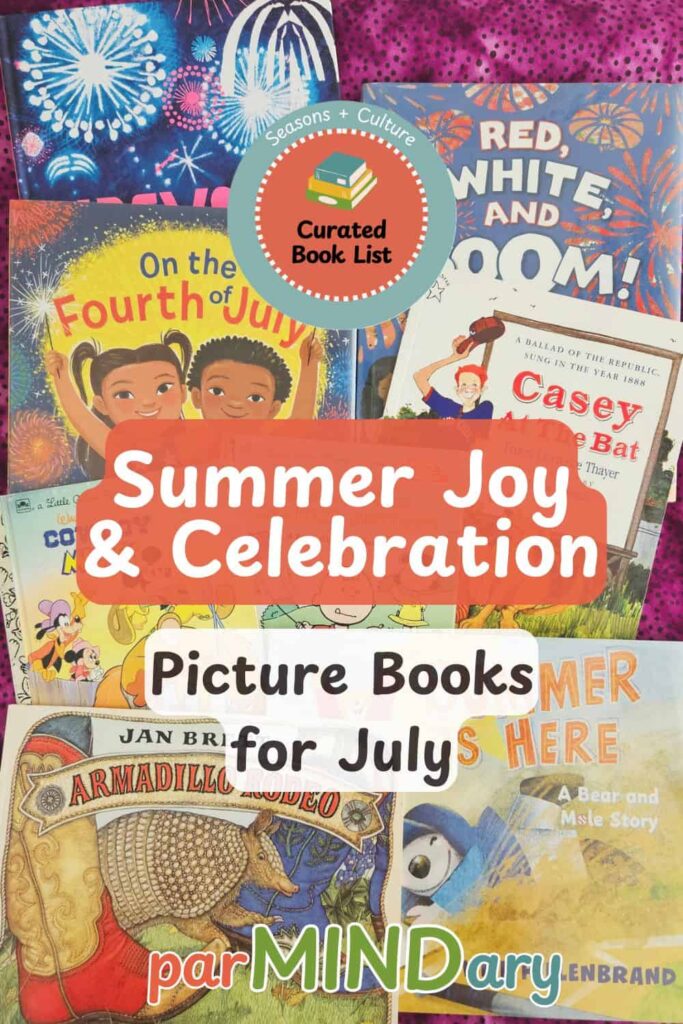
☀️ Summer Joy & Celebration
Midsummer brings its own kinds of excitement.
Kites rise into the wind, baseball games draw crowds, fireworks brighten the evening, and outdoor traditions become part of the season’s rhythm. These moments feel especially vivid against long days and warm summer nights.
The stories in this section capture summer through play, celebration, community events, and shared traditions. Together, they reflect the lively human side of a season already full of movement.
Themes in this Section:
summer play · traditions · celebration · community · perseverance
✦
Let’s Fly a Kite Charlie Brown! – Harry Coe Verr
Follow Charlie Brown and his friends as the seasons unfold through a year of outdoor adventures.
Why this book matters: Flying a kite on an ordinary afternoon turns into a celebration of the changing seasons. This story captures familiar activities that mark the passage of the year. Reminding us that outdoor traditions change with the seasons while returning year after year.
Themes / patterns: seasons, outdoor traditions, friendship, annual cycle, community
Age range: 4–6
Find Let’s Fly a Kite Charlie Brown! on Amazon
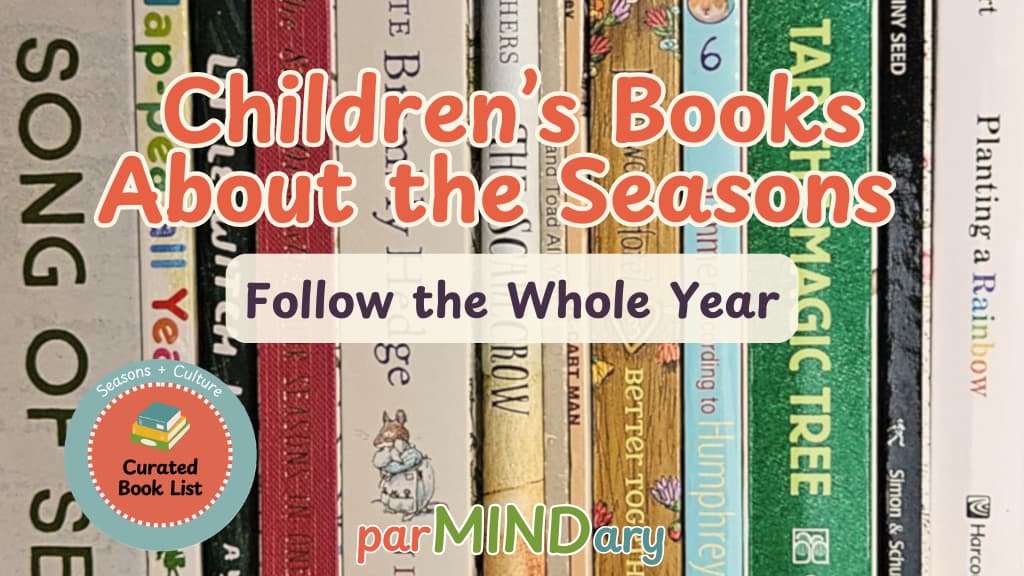
For more children’s books that connect to patterns we return to across the whole year:
Casey at the Bat – Ernest Lawrence Thayer
Step into one of baseball’s most memorable moments.
Why this book matters: This classic poem has become part of American storytelling, capturing the excitement, suspense, and shared experience of summer baseball.
Themes / patterns: baseball, community, sports, storytelling, perseverance
Age range: 4–8
Find Casey at the Bat on Amazon
Summer is Here: A Bear and Mole Story – Will Hillenbrand
Play ball with Bear and Mole as they enjoy a perfect summer day together.
Why this book matters: A friendly baseball game captures the simple pleasures of midsummer—friendship, play, and spending long days outdoors. It reminds us that some of the season’s best memories come from sharing ordinary moments together.
Themes / patterns: friendship, baseball, summer play, outdoor fun, community
Age range: 4–8
Find Summer is Here on Amazon
Fireworks – Matthew Burgess
Experience the anticipation of a summer evening leading up to a spectacular fireworks display.
Why this book matters: Rather than focusing only on fireworks themselves, the story captures the excitement of gathering together, waiting, and sharing a memorable community tradition.
Themes / patterns: celebration, community, anticipation, traditions, summer nights
Age range: 4–8
Find Fireworks on Amazon
On the Fourth of July – Maggie C. Rudd
Spend the day enjoying parades, picnics, and familiar Independence Day traditions.
Why this book matters: Simple moments throughout the holiday encourage conversations about family traditions and the ways communities celebrate together each summer.
Themes / patterns: Fourth of July, family traditions, community, celebration, summer
Age range: 3–6
Find On the Fourth of July on Amazon
L is for Liberty – Wendy Cheyette Lewison
Discover the story behind one of America’s most recognizable landmarks.
Why this book matters: This introduction to the Statue of Liberty explores the history and symbolism of a monument that has welcomed generations of newcomers. It provides a gentle starting point for conversations about freedom, hope, and belonging.
Themes / patterns: Statue of Liberty, history, welcome, immigration, American symbols
Age range: 3–6
Find L is for Liberty on Amazon
Red, White, and Boom – Lee Wardlaw
Join one lively family as excitement builds toward a dazzling fireworks finale.
Why this book matters: Rhyming text and energetic illustrations capture the sights, sounds, and shared anticipation that make summer celebrations memorable.
Themes / patterns: family, fireworks, celebration, community, rhythm
Age range: 4–7
Find Red, White, and Boom on Amazon
Cowboy Mickey – Cindy West
Ride along as Mickey and friends head west for a playful cowboy adventure.
Why this book matters: This lighthearted Disney story blends imagination, friendship, and outdoor adventure with a classic western setting that feels right at home in summertime.
Themes / patterns: imagination, friendship, adventure, western, play
Age range: 4–6
Find Cowboy Mickey on Amazon
Armadillo Rodeo – Jan Brett
Cheer for Bo as one determined armadillo finds his place in a lively rodeo.
Why this book matters: Jan Brett combines humor with careful observations of southwestern wildlife, creating a story that celebrates persistence, belonging, and regional traditions.
Themes / patterns: southwestern wildlife, rodeo, perseverance, belonging, humor
Age range: 2–6
Find Armadillo Rodeo on Amazon
Beyond the excitement of summer gatherings, many lives continue sharing the quieter spaces around us.
☀️ Shared Habitats
Every neighborhood, garden, and wild space is home to more life than we can see at once.
Animals build shelters, insects form colonies, and people sometimes step in when wildlife needs a safer place to live. Even familiar spaces contain overlapping homes, routines, and relationships.
These stories explore the many ways living things occupy and depend upon shared environments. They invite a closer look at habitat, cooperation, adaptation, and the balance that allows different forms of life to remain side by side.
Themes in this Section:
animal homes · neighborhoods · wildlife · stewardship · listening
✦
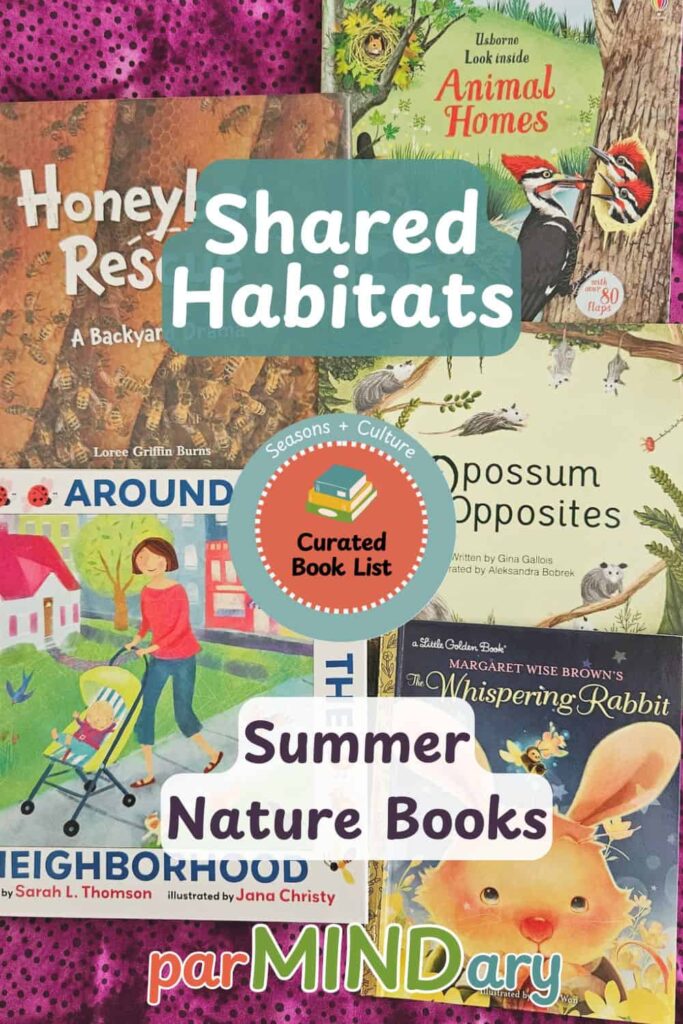
Usborne Look Inside Animal Homes – Emily Bone
Peek inside the remarkable homes animals build in habitats around the world.
Why this book matters: Detailed flaps reveal how different animals create places to live, raise young, and find shelter. It encourages careful observation of the many ways habitats support life.
Themes / patterns: animal homes, habitats, adaptation, wildlife, observation
Age range: 5–8
Find Usborne Look Inside Animal Homes on Amazon
Around the Neighborhood: A Counting Lullaby – Sarah L. Thomson
Take a quiet evening walk through a neighborhood settling down for the night.
Why this book matters: A gentle counting story invites readers to notice familiar homes, neighbors, and everyday moments that create a sense of community. It reminds us that neighborhoods are habitats too.
Themes / patterns: neighborhoods, community, bedtime, counting, belonging
Age range: 2–4
Find Around the Neighborhood on Amazon
Opossum Opposites – Gina Gallois
Learn about opossums through playful pairs of opposites.
Why this book matters: Simple comparisons introduce one of North America’s most misunderstood animals while encouraging curiosity about the wildlife living alongside us.
Themes / patterns: opossums, wildlife, opposites, adaptation, curiosity
Age range: 2–6
Find Opossum Opposites on Amazon
Honeybee Rescue – Loree Griffin Burns
See how a honeybee colony is carefully rescued and given a new home.
Why this book matters: Following a real bee removal, the story highlights the value of protecting pollinators while showing how people and wildlife can coexist. It offers a thoughtful look at stewardship in action.
Themes / patterns: honeybees, stewardship, conservation, pollinators, coexistence
Age range: 5–8
Find Honeybee Rescue on Amazon
The Whispering Rabbit – Margaret Wise Brown
Listen as a curious rabbit discovers the quiet sounds of the natural world.
Why this book matters: Gentle storytelling encourages readers to slow down and pay attention to the small details often overlooked outdoors. It captures the peaceful side of a season that is otherwise full of activity.
Themes / patterns: rabbits, listening, observation, quiet moments, nature
Age range: 2–5
Find The Whispering Rabbit on Amazon
After reading about these connected lives, step outside and look for the relationships already unfolding nearby.
☀️ Seasonal Observation Ideas for High Summer
Gardens are now thick with leaves and flowers. Insects move steadily between plants. Birds, squirrels, and other animals return to familiar places throughout the day. Life continues all around us, even when it appears quiet.
High summer is a good time to notice relationships. Flowers attract pollinators. Plants provide food and shelter. Animals make use of gardens, trees, fences, and hidden corners. People share these same spaces through watering, harvesting, walking, resting, and gathering outdoors.
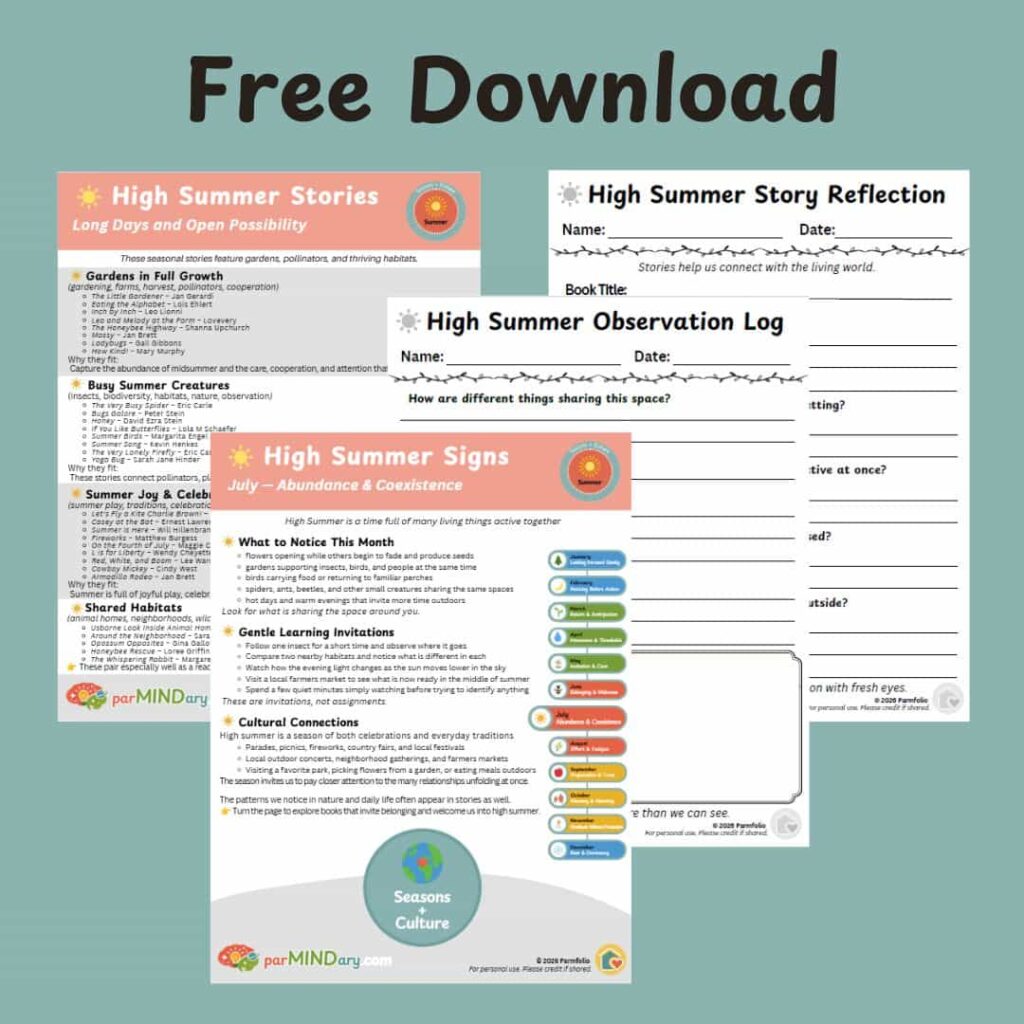
Visit the parMINDary Free Resource Library:
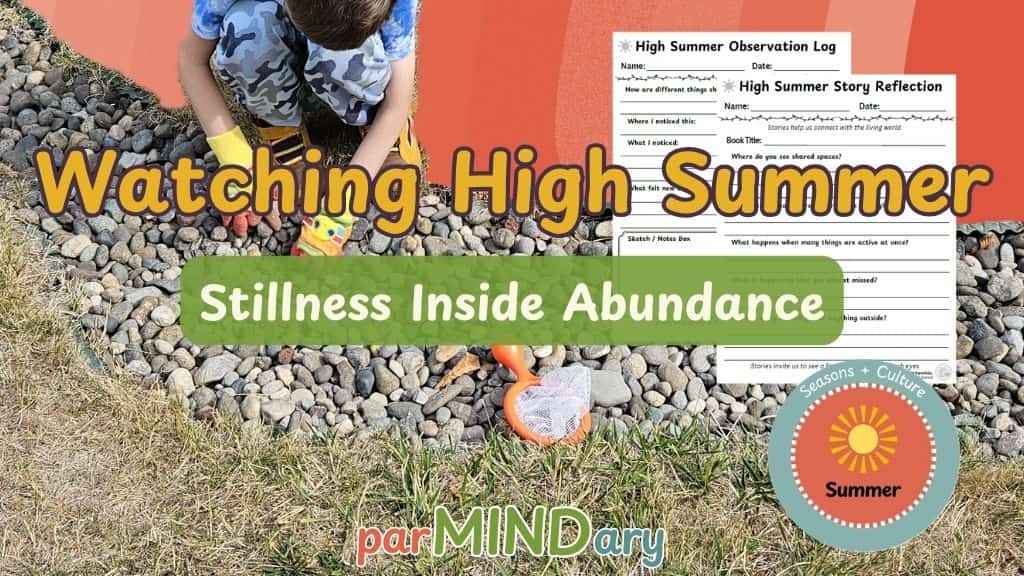
To download the High Summer Observation + Story Guide
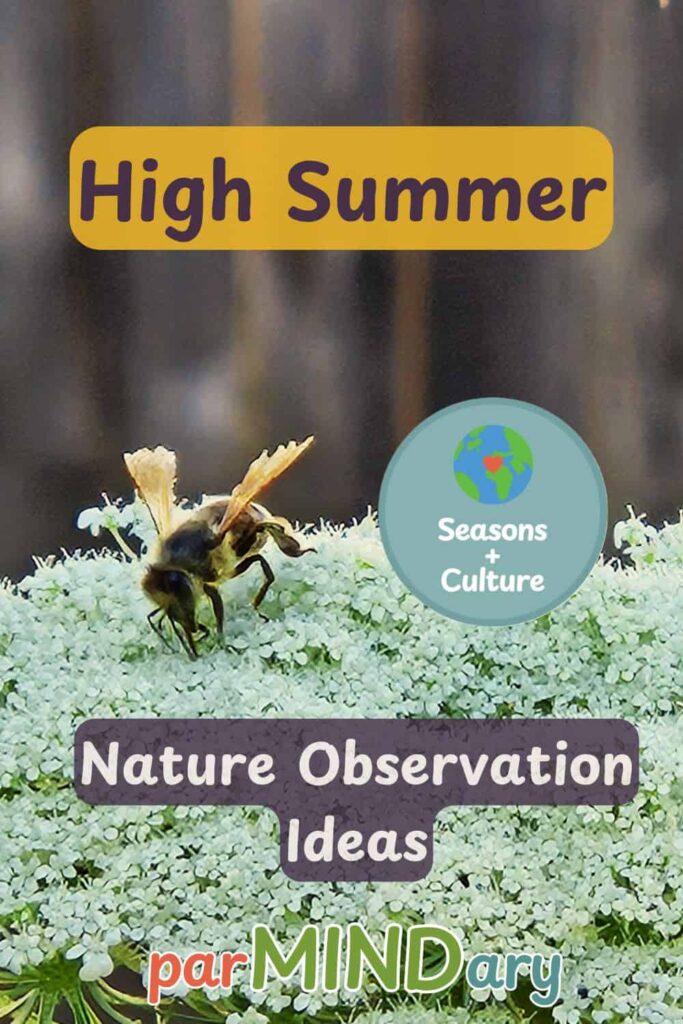
A story paired with a simple observation can bring these connections into focus. Choose a book from the list above, then step outside together and look for the many forms of life sharing the season.
A nature journal or seasonal calendar are our favorite ways to record our observations over time.
You might try:
• Watch one flowering plant.
Sit nearby for several minutes and notice which insects or birds visit. Do they return more than once? Does activity change at different times of day?
• Look for signs of abundance.
Notice fruits, seed heads, thick leaves, tall grasses, crowded flower beds, or vegetables beginning to ripen.
• Find a small habitat.
Look closely at a tree trunk, patch of grass, garden bed, pile of bark, or shaded corner. Who is using that space?
• Compare sun and shade.
Notice how plants, animals, and people behave differently in hot sunlight and cooler sheltered places.
• Listen for summer activity.
Bird calls, buzzing insects, sprinklers, lawn mowers, children playing, and leaves moving in the wind all become part of the sound of high summer.
• Look for cooperation and dependence.
Where do you see one living thing relying on another for food, shelter, movement, or protection?
• Notice what stays still.
High summer is full of activity, but heat can also bring long quiet pauses. Look for animals resting, leaves hanging motionless, or shaded places where the season slows down.
• Record one connected moment.
Draw, photograph, or write about two or more living things sharing the same place.
We recorded our own July observations in the Parmfolio Learning Lab Field Journal.
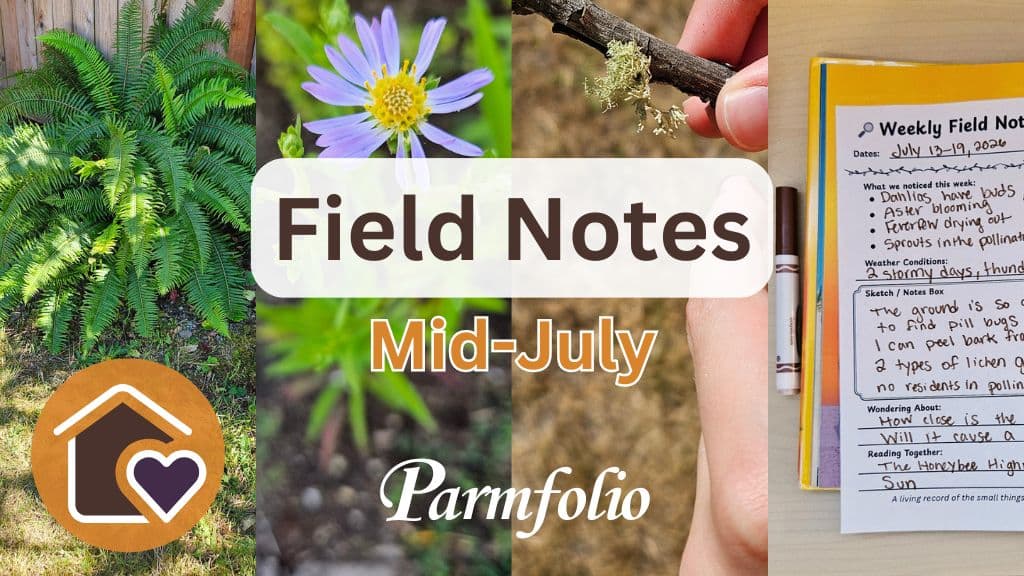
High summer reminds us that abundance is made of relationships. A garden may look still from a distance, but closer observation reveals many lives moving, resting, feeding, and growing within the same shared space.
You can continue the season with our companion reflection post:
🐝July — Abundance & Coexistence
Watching High Summer: Stillness Inside Abundance
Related Seasonal Posts
Explore more seasonal learning ideas on our Seasons & Culture pillar page.
Or follow how we learn to notice the seasonal cycle here:
Watching the Year
🌎 Watching the Year: Homeschooling Through the Seasons
🌲 Watching Midwinter: Renewal and Anticipation
🌙 Watching Late Winter: Staying Indoors and Keeping Warm
🌱 Watching Early Spring: Waiting for the First Signs of Change
💧 Watching Mid-Spring: When Motion Replaces Waiting
🌼 Watching Late Spring: Marking Time Together
🐝 Watching Early Summer: Long Days and Open Possibility
☀️ Watching High Summer: Stillness Inside Abundance
🌾 Watching Late Summer: Holding and Letting Go
🍎 Watching Early Autumn: Preparing for the First Signs of Fall
🍂 Watching Mid-Autumn: The Work of Letting Go
🕯️ Watching Late Autumn: Quiet Before Winter
❄️ Watching Early Winter: Light, Memory, and Celebration
Curated Seasonal Book Lists
🌎 Stories That Follow the Whole Year
🌲 Quiet Deep Winter Stories for Children
🌙 Late Winter & Waiting Stories
🌱 Early Spring Stories for Children
💧 Spring Migration & Movement Stories
🌼 Spring Festivals & May Tradition Stories
🐝 Early Summer Stories for Children
☀️ High Summer Nature & Pollinator Stories
🌾 Late Summer Effort & Harvest Stories
🍎 Migration & Autumn Arrival Stories
🍂 Autumn Harvest & Celebration Stories
🕯️ Gratitude & Community Stories
❄️ Winter Light & Celebration Stories
High summer reminds us that every garden, trail, and neighborhood is filled with connected lives. The more we observe, the more relationships we begin to notice.
Note: Whether you borrow books from the library, purchase them, or share them with friends, the goal is the same: finding stories worth returning to. We visit our local library every week and add a few favorites to our home library throughout the year.